QC lab - vědomostní databáze
Zde najdete vše potřebné o přípravě vzorků
Zde jsou informace o tom, jak se připravují vzorky na analýzu HPLC a GC. Dočtete se zde například o různých typech filtrů a na jaké matrice se hodí, proč na analýzu proteinu ve vzorku nelze použít nylonový filtr k úpravě vzorku před analýzou a podobně.
Příprava vzorku pro HPLC analýzu je klíčovým krokem, který může výrazně ovlivnit výsledky. Zde jsou některé běžné metody přípravy vzorku:
1. Filtrace: Používá se k odstranění pevných částic z kapalných vzorků. Filtry mohou mít různé velikosti pórů, obvykle 0,45 μm nebo 0,22 μm.
2. Ředění: Vzorek je zředěn vhodným rozpouštědlem, aby se dosáhlo požadované koncentrace a kompatibility s mobilní fází.
3. Extrakcí kapalina-kapalina (LLE): Tato metoda se používá k izolaci analytů z kapalných vzorků pomocí dvou nemísitelných kapalin.
4. Pevná fázová extrakce (SPE): Tato technika zahrnuje použití pevné fáze k izolaci analytů z kapalných vzorků. Je velmi účinná pro odstranění interferencí a koncentraci analytů.
5. Derivatizace: Některé analyty mohou vyžadovat chemickou úpravu, aby byly lépe detekovatelné nebo stabilní během analýzy.
6. Centrifugace: Používá se k oddělení pevných částic od kapalné fáze pomocí odstředivé síly.
Každá z těchto metod má své specifické použití a výhody v závislosti na povaze vzorku a požadované analýze.
Typy filtračních membrán:

1. Nylon (NY)
2. polytetraflourethylen – teflon (PTFE)
3. polyvinylidendifluorid (PVDF)
4. polypropylen (PP))
5. acetát celulózy (CA)
6. regenerovaná celulóza (RC)
7. polyethylsulfon (PES)
7. skelná mikrovlákna (GMF)

The classical conventional methods of preparing samples for chromatographic analysis, and at the same time the most widely used procedures in routine practice, are:
• direct extraction and extract treatment
• protein precipitation (PP)
• liquid–liquid extraction (LLE)
• solid phase extraction (SPE)
From a practical perspective, however, these methods are relatively time‑consuming when performed manually. They involve a multistep preparation process and are characterized by relatively high consumption of solvents and sample material. It can be said that they stand in sharp contrast to modern chromatographic trends. While fast chromatographic analysis is completed within a few minutes, sample preparation using these conventional techniques often takes several tens of minutes.
Direct Extraction
Direct extraction generally involves extracting the analyte from a solid matrix. This type of extraction is often referred to as the shake‑filter method. When extracting an analyte from a solid matrix, two limiting factors influence the extraction yield (recovery) and rate: solubility effects and mass transfer. Both factors can be improved by increasing pressure and temperature. This enhances the rate of diffusion and the solvation capacity of the solvents used. Disturbance of equilibrium may occur, where increased temperature can disrupt strong interactions between the matrix and analyte based on van der Waals forces, hydrogen bonding, and dipole–dipole attractive forces between matrix molecules and active sites of the solid matrix. Increasing the temperature of the extraction solvent reduces the viscosity of the liquid, which is associated with high diffusion coefficients that favorably influence extraction kinetics. Surface tension is also reduced, enabling better penetration of the solvent into the particles of the solid matrix.
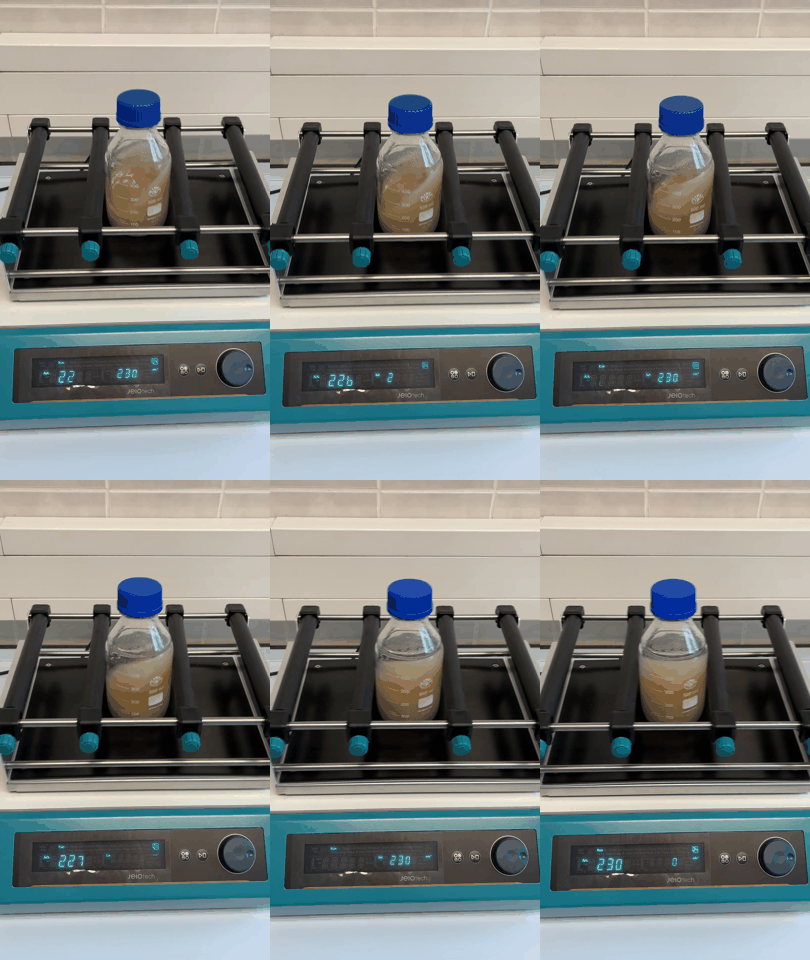
To separate the solid phase from the liquid (extract), filtration or centrifugation is most commonly used. Filtration rate can be influenced by:
• increasing the filter surface area (using folded paper filters)
• increasing the pressure difference Δp before and after the filter (pressure filtration or vacuum filtration)
• decreasing viscosity (by increasing temperature)
• reducing hydraulic resistance of the filtration layer (minimizing the thickness of the filter cake)
• reducing the resistance of the filter cake (using filter aids that preserve a porous structure—cellulose, diatomaceous earth, which form the filter cake and prevent filter clogging while increasing clarity)
• the type of filtration device used (gravity, vacuum, or pressure filtration)
The choice of filter depends on the chemical composition of the mixture. The filter material must also be selected according to the properties of the filtered mixture, the type of solvent, and the content of the solid phase. Generally, filtration is more effective when both phases can be separated completely; in the presence of high starch content or water‑insoluble proteins, this approach often fails. With decreasing organic solvent content in aqueous–organic extraction media, efficiency becomes worse. Gravity filtration or reduced‑pressure filtration (on porous filters/frits or nylon filters) is used. Another possible method of separating the solid and liquid phases is dialysis or ultrafiltration. Their principle is similar: a semipermeable membrane is used whose pores are small enough to retain macromolecular substances but allow passage of low‑molecular substances (ions, amino acids, etc.). Dialysis is based on diffusion of dissolved particles across the membrane; ultrafiltration forces the solution through the membrane by hydrostatic pressure.
In centrifugation, the separation of phases is achieved by sedimentation in a centrifugal field, which results in a higher separation speed. Separation of the solid and liquid phases is carried out in centrifuges. This method is especially suitable when the suspension contains a large amount of solid phase and filtration would be slow because much of the liquid tends to remain in the filter cake.
The obtained supernatant is usually not entirely clear (contains colloids) and often needs to be purified using additional techniques while ensuring that the analyte is not lost. There is a risk of adsorption or the analyte being carried away by auxiliary agents. Purity requirements of the extract vary depending on the analytical method. Special attention is needed when the purified extract will be applied onto a solid-phase extraction column (packed column), where turbid extracts can lead to filter cake formation on the column and its clogging. When using purified extracts for liquid–liquid extraction, turbidity may be problematic due to emulsion formation in the presence of suspended particles.
Another possible method of removing colloidal substances is using clarifying agents that precipitate colloidal particles (e.g., protein precipitation or removal of other high‑molecular substances) or adsorption on suitable carriers. Removal of proteins is especially important when analyzing dilute analytes because proteins form strongly hydrated layers that can interfere with the analytical technique. Neutralization of the sample using neutral or weakly alkaline salts is sometimes used (phosphotungstic acid or Carrez reagents—zinc sulfate with potassium hexacyanoferrate(II)—which form a precipitate of zinc hexacyanoferrate). These reagents remove proteins and their degradation products. Protein precipitation can also be performed using neutral salts (ammonium sulfate), which are effective but may cause problems in later steps due to high salt content of the supernatant. During extraction with organic solvents (absolute ethanol, acetone), proteins are denatured and precipitate; however, lipids are also extracted and must be removed.
Protein Precipitation
Protein precipitation (PP) is a traditional technique for preparing biological samples and is still very popular because of its simplicity and rapid performance as well as method optimization possibilities. Organic solvents such as methanol or acetonitrile are most often used. After precipitation and centrifugation, an aliquot of the clear supernatant can be used for analysis or evaporated. The residue is dissolved in a minimal volume of mobile phase and analyzed. During deproteinization, both large‑ and small‑molecular proteins should be removed. The precipitate must not adsorb the analyte; the deproteinizing reagent must not degrade the analyte or interfere with detection and analytical recovery. When selecting the technique, the chemical composition of the matrix, analyte stability, analyte binding to proteins, filter membrane characteristics, and analyte yield must all be considered. Protein removal is achieved through precipitation, enzymatic degradation, membrane filtration, or centrifugation.
Precipitation may be performed as follows:
• Adding strong acids (trifluoroacetic, trichloroacetic, perchloric, formic, hydrochloric, metaphosphoric). Their disadvantage is strongly acidic supernatant (pH ~1.4–2.7), which may degrade analytes.
• Adding organic soluble solvents miscible with water (methanol, ethanol, acetonitrile). Resulting pH is 5.8–10, but acetonitrile may cause analyte loss due to UV cut‑off.
• Adding multivalent metal ions (zinc sulfate or molybdate salts). The resulting pH should be moderately acidic. These salts form complexes with proteins.
• Precipitation with tannins
• Saturation with ammonium sulfate—resulting pH near 7, but the supernatant has high salt concentration.
• Combination of deproteinization agents
• Heating to 100 °C for 5–10 minutes, although this may cause analyte degradation.
Membrane Filtration
In membrane filtration, proteins from blood plasma or serum are separated using a semipermeable membrane. The analyte remains on the same side of the membrane as the proteins, while the permeate contains only free analyte.
The amount of passed molecules depends on the pore size of the membrane. Membrane filtration includes:
• Ultrafiltration – pore size 1–10 nm
• Reverse osmosis – retains particles smaller than 1 nm
• Microfiltration – retains molecules larger than 10 nm
Membrane filtration is widely used due to its very high efficiency (up to 99%).
Solid Phase Extraction
Solid phase extraction (SPE) is clearly the dominant technique in the field of sample preparation prior to chromatographic analysis because it offers many advantages, such as high analyte recovery, reduced consumption of organic solvents compared to previously mentioned procedures, and better possibilities for automation. During SPE, analytes are extracted based on the principle of distribution or other interactions between the solid phase (extraction sorbent) and the liquid phase (sample containing the analyte). For successful extraction, the analyte must have a higher affinity to the solid phase than to the sample matrix. Retention can occur on the basis of polar, non‑polar, ionic, and affinity interactions. The SPE principle is illustrated in Fig. 50 and forms the basis of many modernized microextraction procedures.
Selection of the stationary phase
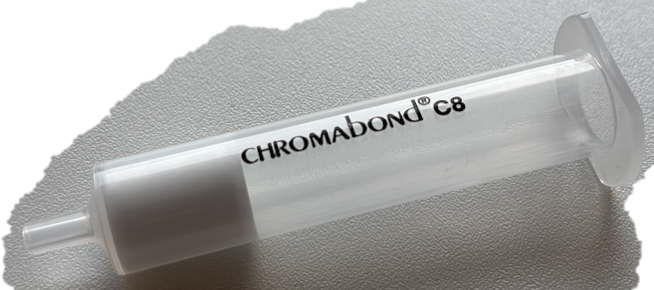
Sorbents used as packing materials for SPE columns are similar to those used in HPLC. A wide range of sorbents is now available, from classical non‑polar C18 and C8, polar phases (silica gel, activated alumina, Florisil, cyano, aminopropyl, diol), through ion‑exchange materials and a variety of polymeric materials (PS‑DVB = polystyrene‑divinylbenzene, PMMA = polymethyl methacrylate) and more, enabling sorption of analytes with diverse physicochemical properties. A key advantage of polymer sorbents is their stability in a broader pH range compared to silica‑based sorbents. Current trends include multi‑modal sorbents combining non‑polar groups such as C18 with ion‑exchange groups such as SCX or SAX
Initial extract adjustment
To transfer the sample into the liquid phase, it is necessary to modify the liquid medium so that it is compatible with the stationary phase (changing the concentration of organic content, adjusting pH or ionic strength). These steps aim to remove solid particles from the solution to prevent frit clogging and formation of a compact layer that would limit access of the analyte to the sorbent. Solvent selection is also important to ensure analyte retention on the SPE column. For example, solutions with a high organic content cannot be applied onto a column designed for aqueous phases; such samples must be diluted and introduced onto the SPE sorbent in several aliquots.
Wetting (conditioning) of the sorbent
The purpose of sorbent wetting is activation of its functional groups and preparation for extraction. The most common conditioning agent is the solvent used in the following step. Complete miscibility of the applied solvents is essential (with few exceptions mentioned later).
Equilibration of the stationary phase
The goal of column equilibration is to create a phase‑equilibrium environment that corresponds to the conditions under which the sample will be applied. Equilibration is carried out with a solvent that most closely matches the composition of the sample.
Sample application
During sample loading, the flow rate (loading flow) must be optimized. This parameter is highly variable.
Removal of interfering substances
Removal of interfering compounds is performed using one or more washing steps. In this step, solvents are selected such that the analyte remains retained while interfering substances are removed—typically using pure water for removal of hydrophilic impurities. For reversed‑phase SPE, buffers containing a small amount of organic solvent are often used; these must remove matrix components while not causing premature analyte elution. For ion‑exchange SPE, pH and ionic strength of the wash solutions are key and must be optimized for each procedure.
Analyte elution
The choice of solvent for analyte elution depends on its compatibility with the final analytical technique. Elution flow rate is usually comparable to the flow during sample application and must be optimized. Flow rates used during column conditioning must be consistent. A solvent immiscible with the previous washing solvent may be applied, but an important step before elution is gentle drying of the extraction column (using a stream of air or nitrogen). During analyte elution, the so‑called elution profile is monitored, representing the dependence of analyte amount (concentration, %) on the volume (V) of mobile phase (elution solvent) passed through. The elution profile behaves similarly to chromatographic zones (peaks) and is subject to the same requirements as a chromatographic zone. It should primarily be narrow and symmetrical. The shape of the elution profile depends, as in liquid chromatography, on conditions of the chromatographic system (stationary phase – mobile phase). Elution profile determination is important during SPE optimization. An absolutely essential step is to test extraction efficiency on a chromatographic column and thus choose appropriate chromatographic conditions. The practical procedure consists of applying a defined volume of extract onto a chromatographic column and monitoring analyte content in the eluted fractions using an appropriate analytical method. The development of an SPE procedure is therefore relatively simple and has many similarities with elution chromatography. SPE can be performed manually or automated in both on‑line and off‑line formats. Handling a vacuum manifold for SPE is relatively easy, but two aspects must be considered: control of flow rate and ensuring that the sorbent does not dry out completely, as drying may affect most SPE sorbents. There are exceptions, for example Oasis (Waters) or Abselut (Varian) extraction cartridges, which tolerate complete drying of the sorbent at any step without harm. A drawback of classical SPE procedures is the need to dissolve the extract, and in many cases, the need to evaporate the extract and re‑dissolve it in the mobile phase. SPE cartridges are usually produced for single use, which significantly increases their economic cost. A disadvantage in terms of method reproducibility is the possibility of differences between cartridge batches from the manufacturer.